Understanding the Building Blocks of Performance, Recovery & Longevity
Introduction
Understanding the difference between amino acids, peptides, and proteins is essential if you’re exploring topics like nutrition, recovery, or general wellness.
While these terms are often used interchangeably, they each represent different levels of biological structure and function. This guide breaks them down in a simple, accurate way—so you can better understand how they relate.
What Are Amino Acids?
Amino acids are organic compounds that serve as the basic units used by the body to build larger molecules.
There are 20 standard amino acids, which are commonly grouped into:
Essential amino acids (must be obtained through diet) Non-essential amino acids (can be produced by the body)
They play roles in many normal physiological processes, including:
Supporting tissue structure Serving as precursors to other biological compounds Contributing to enzyme and hormone production
At this level, amino acids are best understood as individual components—not complete systems.
Why They Matter:
Muscle repair & growth Energy production during workouts Preventing muscle breakdown (catabolism)
Bottom line: Amino acids are raw materials—but they don’t do much on their own without structure.
What are Peptides?
Peptides are short chains of amino acids linked together, typically consisting of 2–50 amino acids.
Because of their size and structure, peptides are often involved in cell-to-cell communication and signaling processes within the body.
Examples of naturally occurring peptides include:
Certain hormones Signaling molecules Structural peptides like collagen fragments
In simple terms, peptides can be thought of as functional sequences that help regulate biological activity.
Why They’re Elite:
Unlike amino acids or proteins, peptides act like instructions, not just materials.
Think of peptides as messages sent inside your body.
What are Proteins?
Proteins are larger, more complex molecules made up of long chains of amino acids—typically more than 50.
Once formed, proteins fold into specific shapes that determine their function.
They are involved in a wide range of normal bodily functions, including:
Structural support (e.g., muscle, skin, hair) Enzymatic activity Transport and storage of molecules
Proteins represent the fully formed structures built from amino acids.
The Key Difference (Simplified)
To bring it all together:
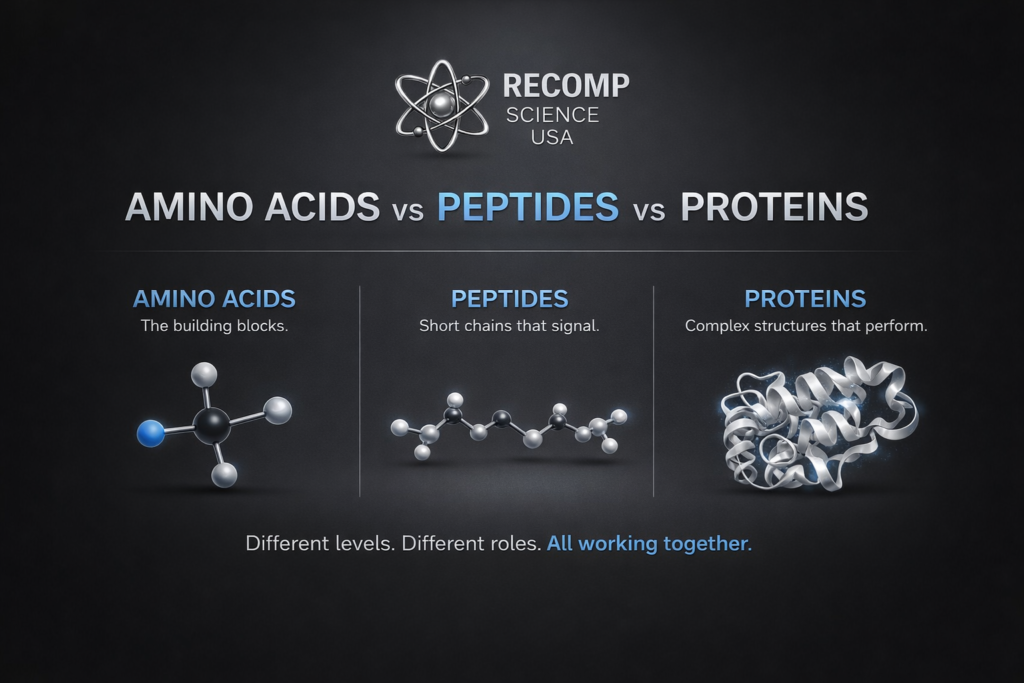
Amino Acids → Individual building units Peptides → Short chains with functional roles Proteins → Larger, complex structures with diverse functions
Each level builds on the one before it.
Why This Distinction Matters
From an educational standpoint, understanding these differences helps clarify:
How the body organizes biological structures How smaller molecules contribute to larger systems Why terminology matters when reading research or product information
It also helps you better interpret topics like:
Nutritional labels Ingredient lists Scientific or wellness-related content
Final Thoughts
Amino acids, peptides, and proteins are all part of the same biological system—but they operate at different levels of complexity.
Understanding how they connect gives you a stronger foundation when exploring health, fitness, or general science-based topics.
If you found this helpful, you may want to explore these related topics next: